
I sat down a few months ago (ok, almost a year ago) and I said to myself, “I really liked this movie. I should write something simple about Captain Marvel.” As it turns out, I have way too much to say on this topic… well, not too much, but enough to warrant a lot of edits, re-edits, and different article configurations.
So here we are. I decided I was not going to split all my thoughts into different articles, instead I’ll try to make this an all encompassing thing. My last word on the subject if you will. And what better time to do it than for the anniversary of its release.
Overview
Carol Danvers’ story is a worthy addition to the pantheon of Marvel origin movies. This is the tale of a woman whose memory of her own past is fractured and incomplete, plagued by nightmares and full of desire to prove herself worthy of the greater cause she has been recruited to defend.
Entrusted with great power we find “Vers” (Carol’s Kree name) in the Kree homeward of Hala, training to be a part of a select group of elite warriors who fight to fend off the Skrull, an evil race of shapeshifters who pose a threat to the universe.
Vers’ main flaw is her fiery temper and strong emotions, something seemingly inadequate for a Kree Warrior. From the start it’s made clear, this isn’t a hero who doubts her abilities, but she’s in a struggle to get others to see her worth. Hers is a journey of self discovery, where her path leads her from seeking approval to understanding her place in the universe.
For it’s 21st film within the Marvel Cinematic Universe, Marvel Entertainment delivers a thoroughly entertaining movie that stands proudly along the best “origin” movies of the collection, with it’s own unique style of humour and a few of the winks we have come to consider as marvel classics.
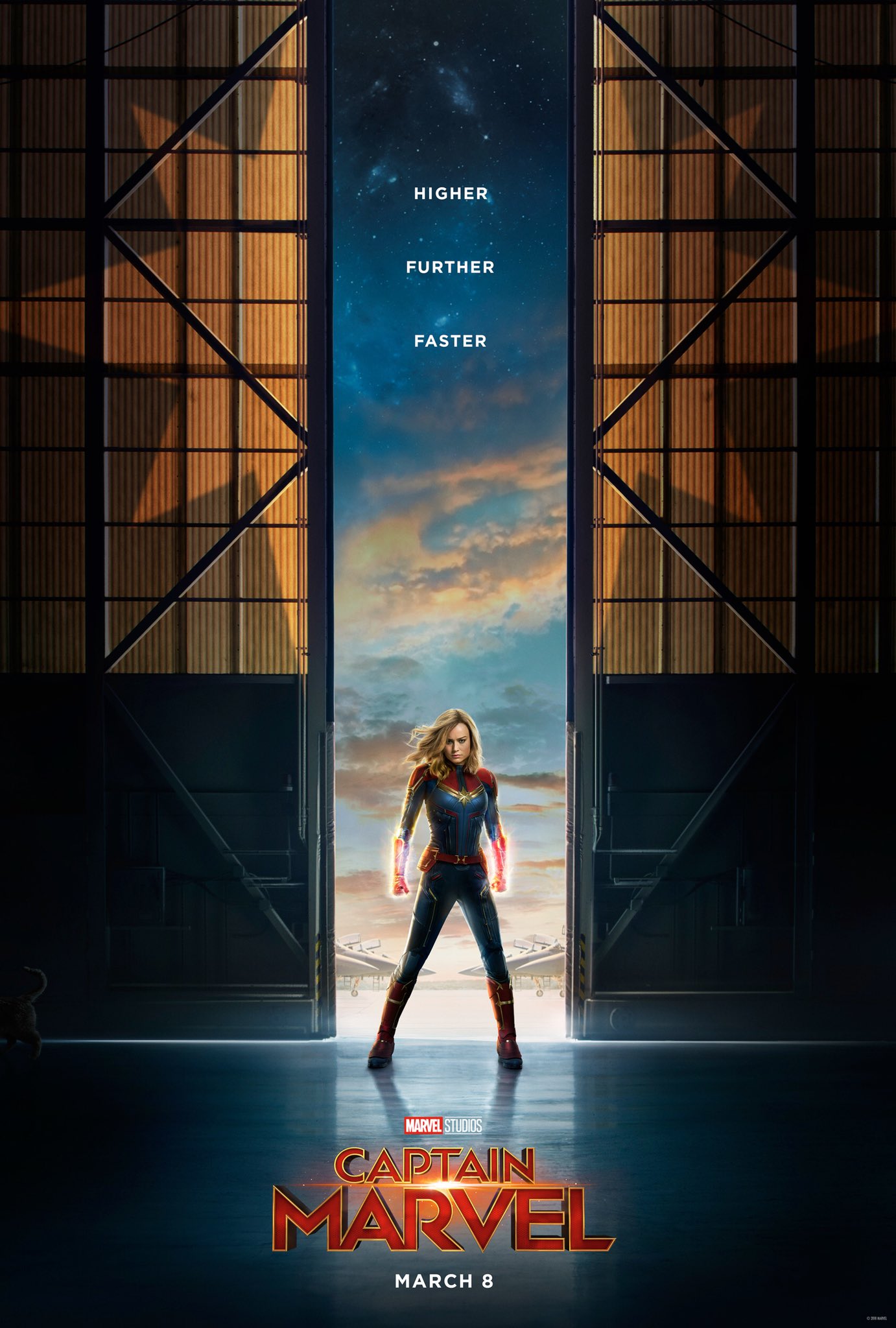
The first female led marvel film has Brie Larson play Carol Danvers/Vers/Captain Marvel, Samuel L. Jackson returning as Nick Fury, and an incredible cast which includes Ben Mendelsohn as Talos, Jude Law as Yon-Rogg, Lashana Lynch as Maria Rambeau, and Annette Bening as The Supreme Intelligence/Dr. Lawson/ Mar-Vell.
Well then, that’s the end of the objective overview for the movie. Right here is where a disclaimer would go if I was into that sort of thing. But if you’ve come to this blog it means you’re good with reading pieces written by an opinionated woman. So I’ll just be upfront about it…
I loved this movie.
If that is a “dealbreaker” and you feel this article is any less “worthy” for it, here’s your opportunity to leave. I am biased, yet if you’ve found the writing and opinions on this blog to your liking, this is what will make this text worth your while.
Higher, Further, Faster, More
I first heard about Captain Marvel around 2012, but didn’t get to read the book until early 2014. I soaked up all of the Deadpool comics I could get my hands on, but I also read up as much of Carol Danvers as I could.
Starting the spring of 2014 and for a couple years afterwards I read the entire Matt Fraction and David Aja’s run of Hawkeye, most of The Dark Tower comics until then, The Umbrella Academy, some of Marvel’s 1602, House of M, Origin, and a bunch of other titles available through Marvel Unlimited and my local comic book dealer. My big immersion into comics ended mid 2016, right in the midst of The Mighty Thor series.
This was due partly to lack of funds to keep buying/subscribing, but also because the small place where I got my prints was very badly managed and the flow of comics slowed gradually until it stopped.
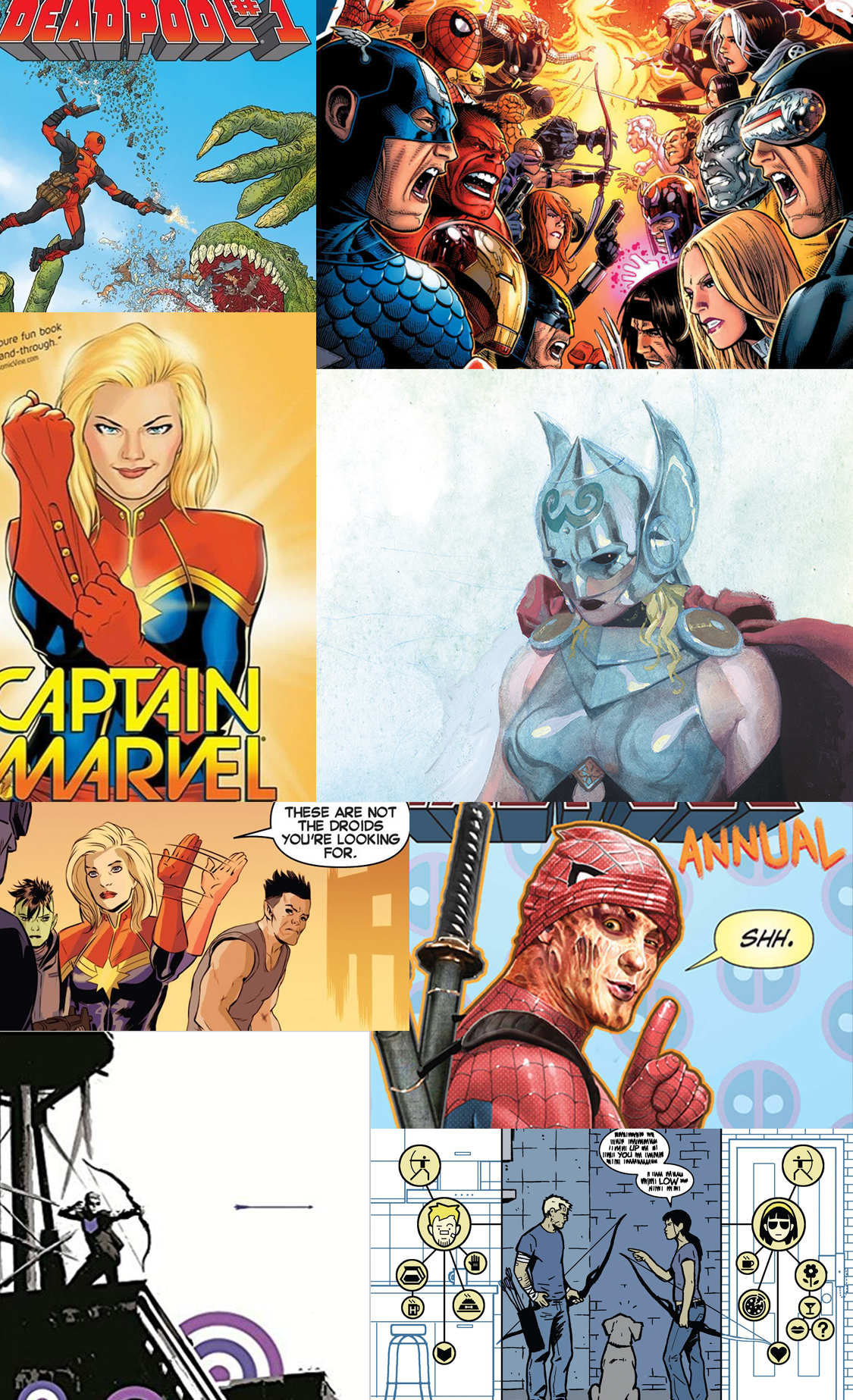
I had never read about a super-hero with whom I could identify as much as I could with Carol, the feats and prowess she displayed within the comic book pages was only enhanced by how grounded and self aware she was. Never doubting to do what was right, even if it meant ugly decisions and weighting odds in a way someone like Captain America would only feel squeamish about. This was a woman who knew the needs of the many outweigh those of the few, someone who would not hesitate to pull the trigger but who would allow herself to feel the repercussions of her choices. A hero grounded enough to recognise her selfishness and flaws, and try to overcome them (not always successfully either) in a way that felt very real.
She was a complex character, a hero I felt was human: less self-righteous than Captain America, yet much more conscious of others than someone like Thor or Tony Stark. With a lot of sass and smarts to boot.
Suffice it to say, I loved Carol Danvers immediately. Here was a hero that lived on the statue of liberty (as I started with the Kelly Sue DeConnick run), who loved classic rock, who was an utter nerd, and had named her cat Chewbacca. Also, we had the same name.
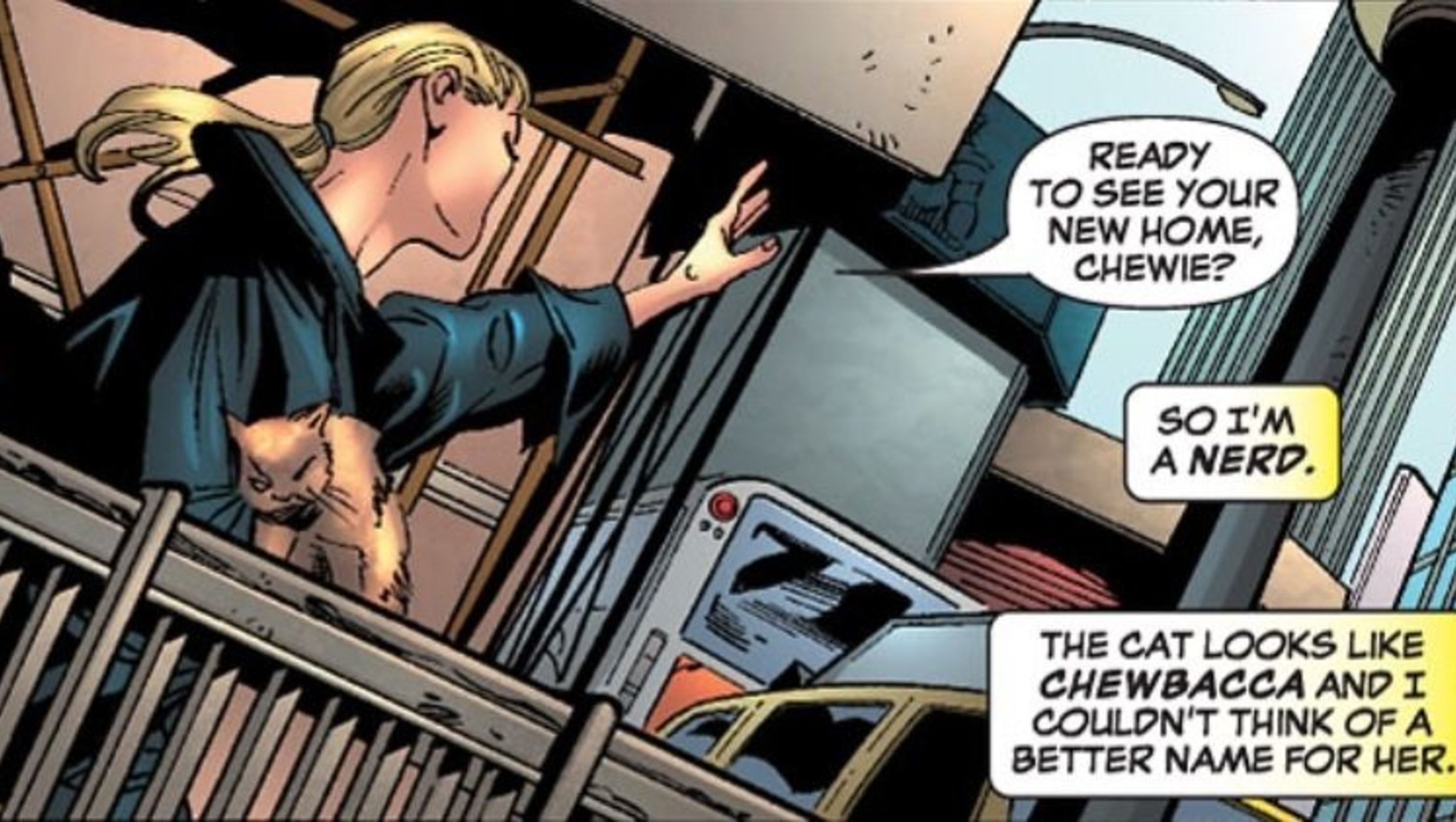
Carol Danvers is a hero who faces adversity and danger straight in the face, and proceeds to kick ass and sass her way through.
When we talk about the movie we don’t even have to say that it’s not a perfect film, no Marvel movie is. But this is a movie that has a lot of power, a movie that chose what story it wanted to tell, and got busy telling it. The narrative is simple enough and at times predictable, but the honesty with which is told is something we don’t get too often with some of Disney’s most recent films.
Captain Marvel is a perfect summary of what makes this hero great, cleaning up a -sometimes complex- origin story, and giving us an avenger who is worthy of the name.
Let’s break it down.
The story starts off relatively slow. While the first act is possibly the weakest part of the movie, it also manages to subtly convey the “sameness” and underlying frustration that define what Carol’s life has probably been like for the last few years.
There is a feeling of routine in everything that is shown. We can see that although she considers herself Kree -not an outcast- and has a good relationship with her mentor, the powers that be (aka. the supreme intelligence) still consider her not to be “ready” for missions. Even though she’s been training for it for years at this point.
The fact that her memory is unreliable and that her emotions are “unstable” is a point that the movie brings across over and over again. It is very telling that her mentor (Yon Rog) is more concerned with her ability to control her emotions than anything else about her training. Her physical abilities are never questioned, her self control is.
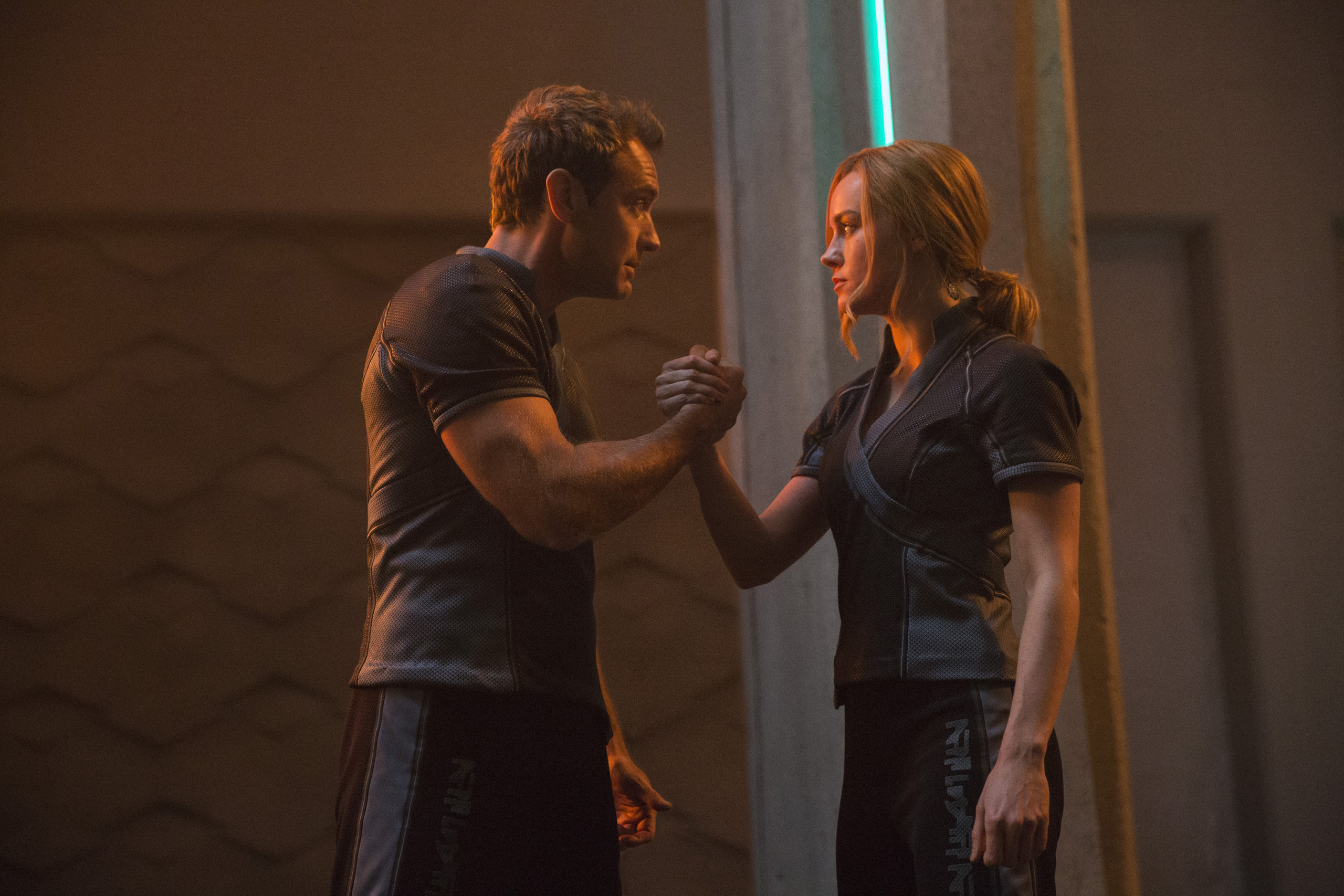
Any woman who has worked in a male dominant environment can relate to those remarks, to being urged by the system to avoid showing emotions, that “women are emotional” and that emotions make us weak and we should learn to be restrained.
Carol (Vers to the Kree) gets shipped on a mission with Yon-Rogg and his team in the last segment of this “establishing” first act of the movie. Unsurprisingly, the mission turns out to be a trap and Vers is caught by Talos -yet another excellent actor hidden under loads of makeup by Marvel-. Ben Mehndelson’s character is one of the highlights of the movie, and his delivery of the Skrull leader leaves us torn between love for his wit and our preconceptions of his kind from the get go. The movie is subtle about the undertones of colonialism and oppression, yet easy enough to see to anyone who isn’t distracted by the visual effects.
The Skrull seem to be looking for someone, and somehow she is the key. A glimpse into her memories leads us to believe something is astray.After showing us a little bit of what her powers can do, Carol manages to escape. We are left wondering what the hell actually happened to her memories, and why on earth is her blood blue if it’s so evident that she’s actually Air Force?

Vers steals an escape pod and sets a course to planet C64. Her escape pod crashes in the middle of a blast of ‘terran’ 90’s nostalgia, from movie totems of Schwarzenegger inside Blockbuster; to Smashing Pumpkins posters plastered next to a rigged telephone booth outside Radio Shack.
With bits and pieces of information and an inkling of who the Skrulls might be looking for (the woman in her dreams and possibly the key to her incomplete memories), she decides to ditch the orders of her commander to “stay put” and go looking for answers. Not without bumping into our old (young?) friend Nick Fury, in what has to be Marvel’s best display of de-ageing effects so far.
Nick Fury shines as a sidekick because Carol quickly accepts him as an intelligent man, someone in charge, and equal to her, even if less informed of interplanetary affairs. And because of Samuel L. Jackson’s delightful performance as the future leader of Shield.
Nick represents a striking first contrast to Yon Rogg; who to this point has been the only other to interact closely with Carol. While Yon Rogg second guesses Carol’s ability to be in control, despite knowing she’s very powerful. Meanwhile, Nick Fury trusts Carol’s gut, even though he is at a clear disadvantage: he has no idea what is going on, or if this woman is as capable as she says she is; yet we see him act as one should, taking things seriously and believing as he sees. The moment Carol proves herself trustworthy (not powerful, but reliable), he doesn’t hesitate to follow her lead.
The fact that he is a sidekick in this movie does not make him any less badass than he was before, and if we think otherwise perhaps we need to examine our biases.
The movie takes both Carol and Nick through a path of discovery, of things forgotten and unknown for both of them, succeeding in placing us in the characters’ shoes. We are confined to taking information at face value as Carol delves deeper into her past, and particularly into finding the people who used to be central in her life, namely Doctor Lawson and Maria Rambeau. By the time Carol and Nick make it to Maria’s home they’ve been blindsided a couple times by the Skrull -they’ve taken the identity of Fury’s superior, of Coulson, and of a bunch of different people-. We are not sure who to trust, specially because some things don’t seem to add up.
The scenes in the Rambeau household are probably one of the most emotional ones ever in a Marvel Origin Film, as the emotional core of the story is unwrapped by Maria and her –adorably sassy– daughter Monica. Through their eyes we see who Carol Danvers is, it’s revealed to us the extent of her family and how much Dr. Lawson meant to both pilots.
Lawson is the person Carol most admired and respected, the one who trusted Carol and Maria when no one else in the Air Force will give them a shot at trying their skills just for being women. This has been so deeply etched in her subconscious that even without remembering Lawson, the supreme intelligence would take her form when facing Carol.
We get to see how warm, carefree, fun, and tenacious Carol was before she disappeared, and Carol’s relationship with Maria is shown to be the emotional linchpin of the film.
By having Maria’s side of the story (and Carol’s airplane’s black box) we are given a sense of “the other side of the story”, and the movie proceeds to show us the many ways in which the Kree are hurting planets, races, and people; even those who have no idea who they are.
The truth is unmasked and we learn that, as every imperialist nation, the Kree have created a tale to continue an “unholy war,” as Mar-Vell (Dr. Lawson) words it. Talos confirms the truth revealed by Lawson, that the Skrull have been on the run from the Kree’s predatory ways.
The signs of the Kree Empire’s real face were there all along, and Carol surprises us in the way she takes the shocking reveal. More than going into a spiral of self doubt or self pity -like other heroes do, brooding over the possible courses of action until their path is revealed-.
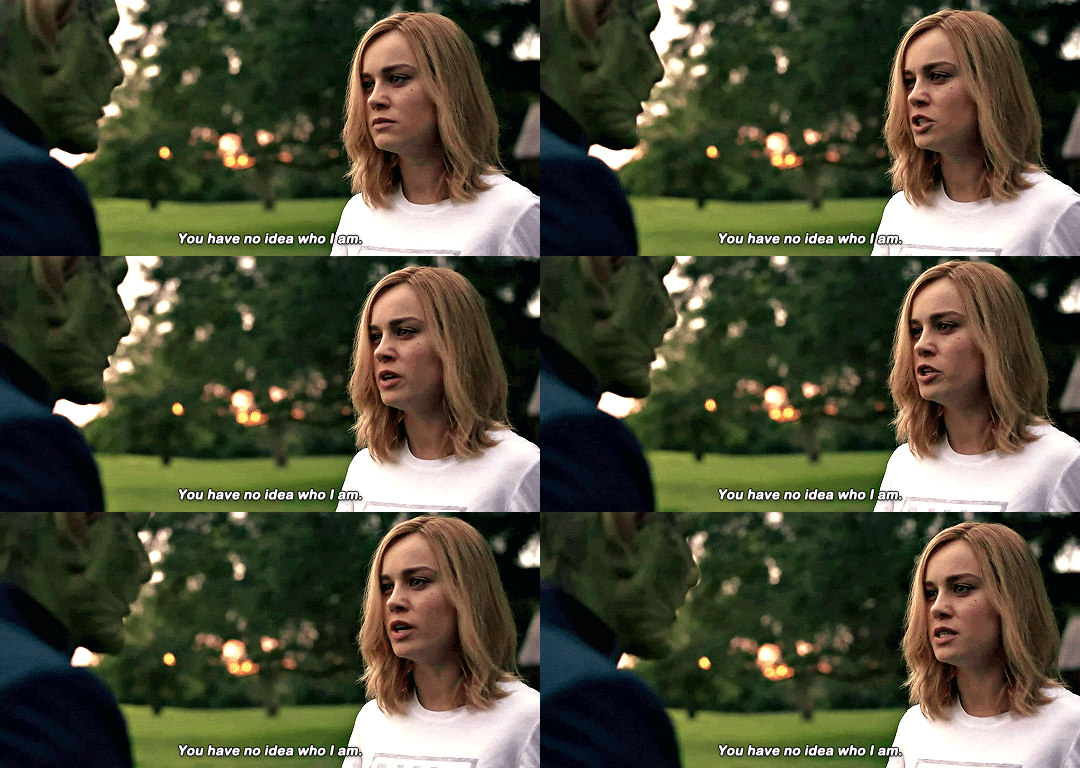
All of this continues to deepen the personal assault represented by the Kree’s betrayal of both Carol and Lawson before her. The Skrull ask for Carol’s help as she assimilates the extent of her hurt, and Carol breaks down. She crumbles emotionally like someone who has had just too much dropped on her plate should.
Lucky for us, her best friend Maria is there to tell her to chill the F* up. This one time Marvel decided to subvert expectations and give us a badass grounded friendship as the emotional hook of the film instead of trying to force a traditional romantic plot where it wouldn’t have made sense to the overall story.
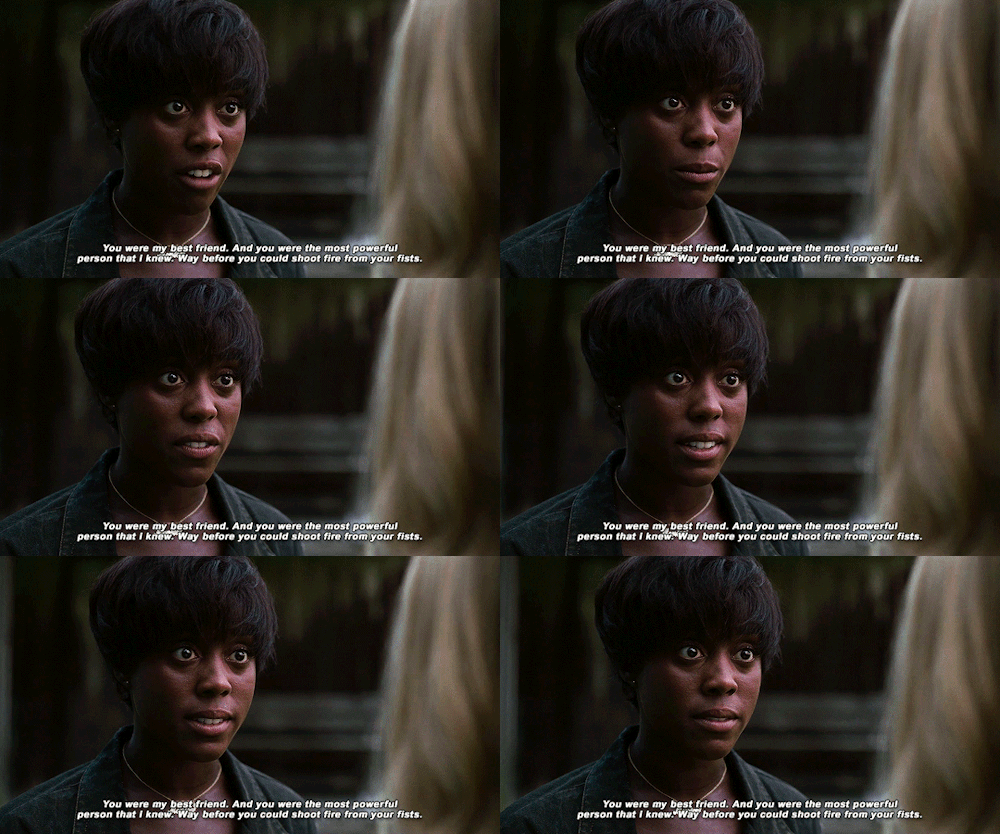
The second act wraps up with a new plan, as Carol completes another step in her journey, embracing the help of others, tossing away her preconceptions of right and wrong as she realises how the Kree have distorted the truth in their own path to colonising the universe.
After agreeing to collaborate, Carol and her newly formed crew arrive at Mar-Vell’s laboratory in orbit, and one last tidbit of information is revealed to us: Mar-Vell was aiding Skrull refugees to find a new home world. This is very important on a character level, as we get to see a softer side of Carol, a woman who never finches to do what is right, but now understands that right and wrong in war are two sides of the same coin, someone always gets hurt, no matter your intentions.
Marvel timing proceeds to cut short any prolonged emotional reaction we might have, and the Kree arrive just in time to get everyone from Skrull to human, binding Carol in some sort of organic slash electronic webbings. She is to confront the Supreme Intelligence, as she’s still “Vers” to the Kree
We are transported to the mental space in which the Supreme Intelligence commutes with the Kree (Nirvana soundtrack and all), for the peak cathartic moment of the film.
The Supreme Intelligence (still with the face of Dr. Lawson) echoes Carol’s own doubts, in what feels a bit like a recount of Carol’s emotional turmoil. But she’s grown, and now being confronted with the core of the Kree hive directive, Carol has never felt more sure of herself. Now she knows who she is, but still she feels lingering doubt… Is she just her powers?
Much like the alcoholic writer who thinks they cannot write without alcohol, Carol Danvers is broken down as she is reminded of every defeat she’s suffered through her life. But she is also reminded that “she’s only human”, giving us a sense of victory as she realises that just being human is more than enough. And that her true power lies in knowing and accepting herself.
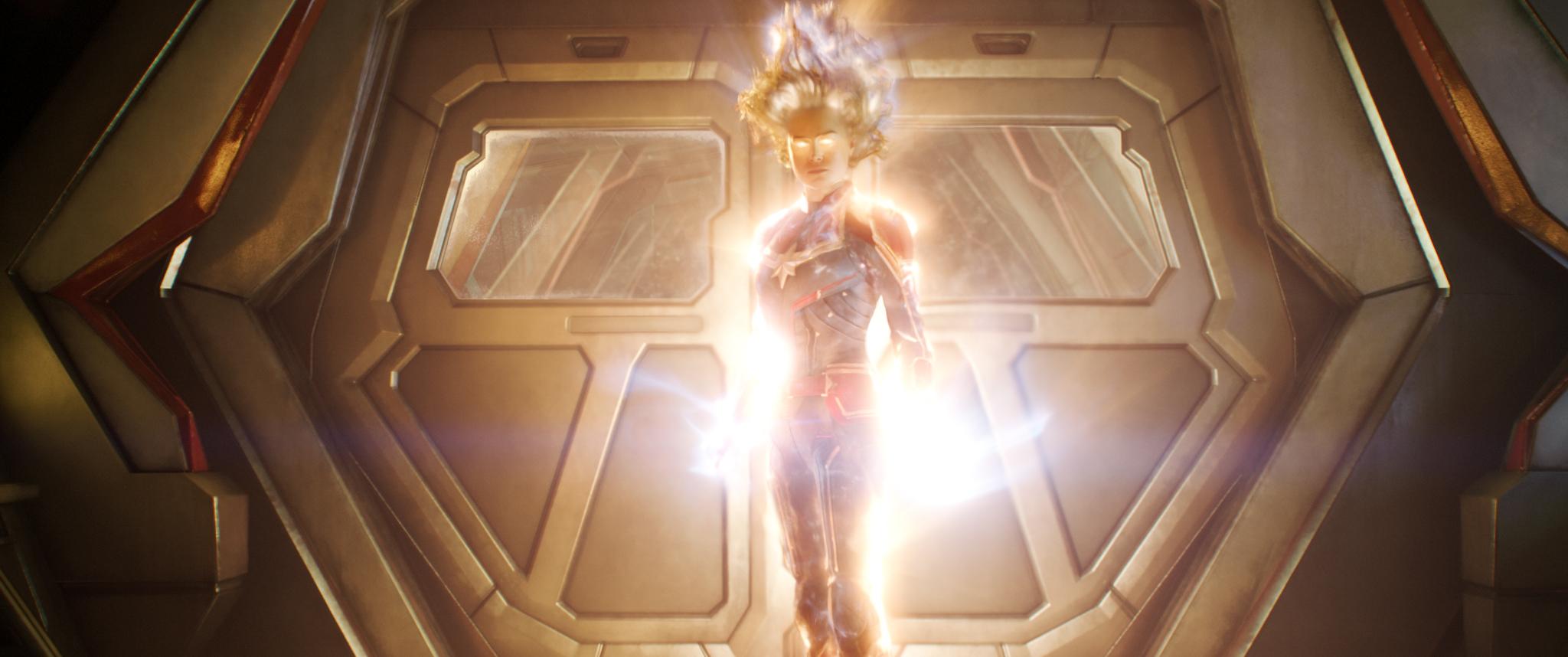
And what would be of a superhero movie without a couple of final battle showdowns, some one on one combat, unexpected threats and a splash of ship to ship fights?
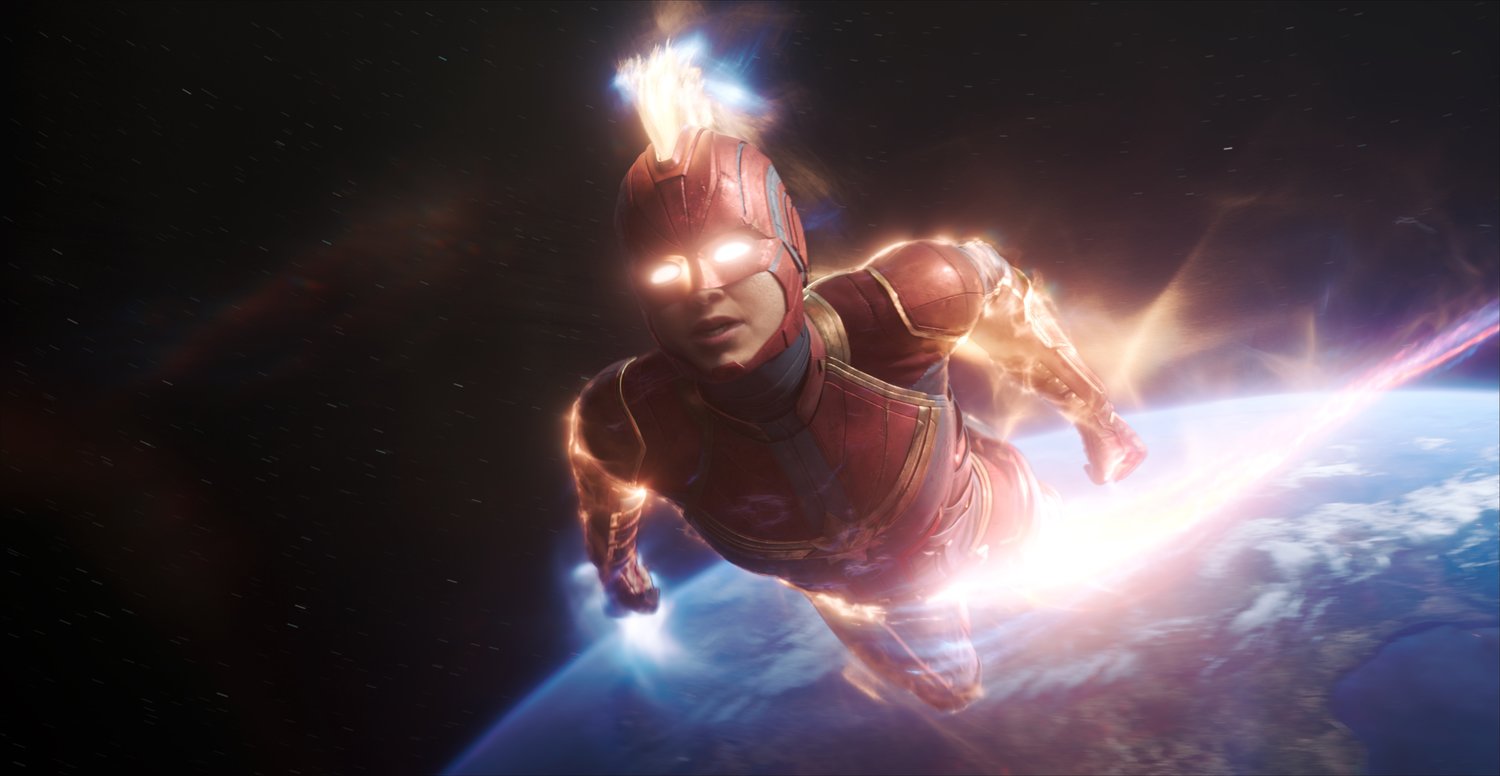
The wrapping moments of the film might be too crowded, but they’re definitely exciting. The full force display of Danver’s powers feels both exhilarating and very much pulled out straight from the pages of a comic book. The fights have humour to spare, yet never out of the sarcastic tone that defines her character; and Captain Marvel’s destruction of Ronan’s ships is as unlikely and as exciting as the destruction of the Death Star by the hands of a moisture farmer.
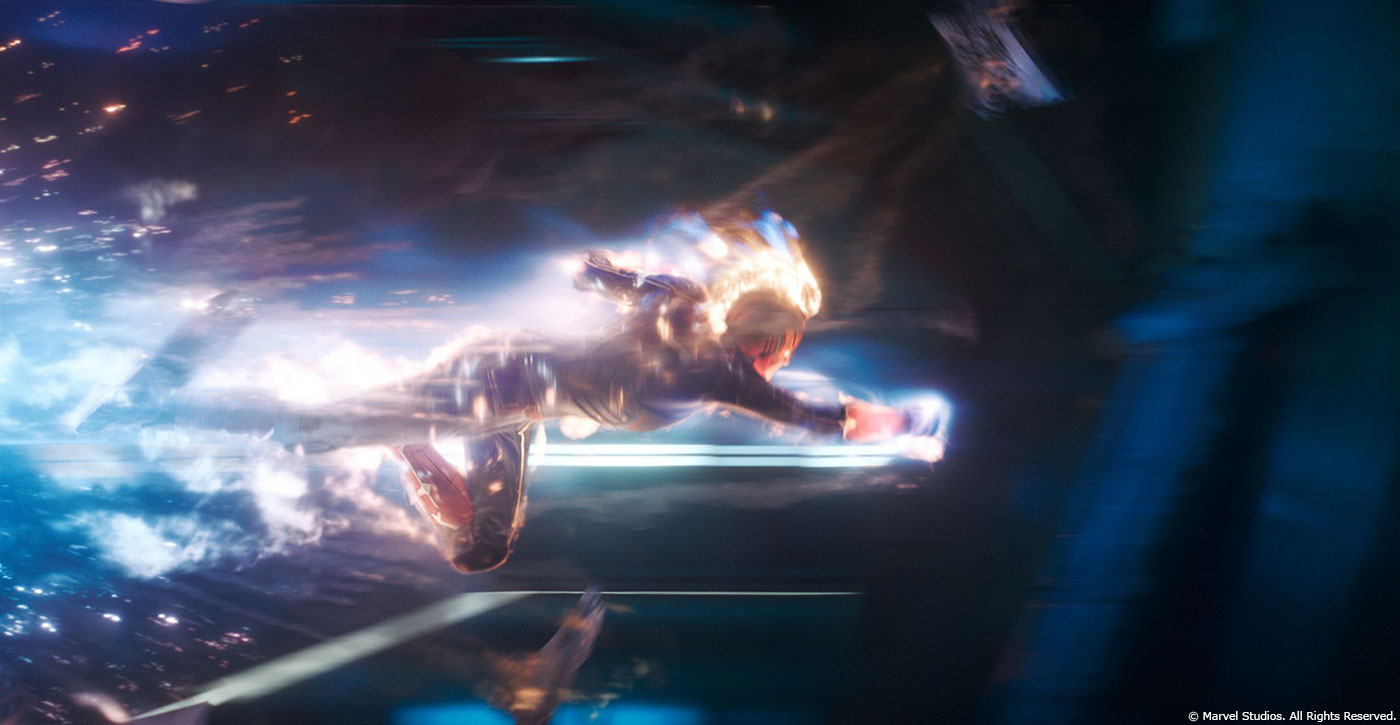
This movie has fun with itself at many levels, and one of the most evident ones has to be the final confrontation she has with Yon Rogg.
In true villain form, he attempts to shake himself of all responsibility, trying to appeal to the hero’s good nature, believing that “Vers” is still looking for someone’s approval –his approval– and not realising that she has grown past that. He adopts a condescending attitude (again something women can identify with) and tries to coax her into fighting him with “no powers” to prove herself.
Carol is silent through his entire monologue, weighting him down and deciding to take the high road. She gives him no more than what he deserves, none of her time or much of her attention, as she simply blasts the Kree away Indiana Jones style.
The Kree are defeated for now as Carol sends Yon Rogg back to Hala with a promise, to end everything they stand for. And we believe her as she says so.
In any male super hero movie, the mentor’s taunt would have succeeded and an “epic final duel” would have followed. Instead Carol gives Yon Rogg the only response that one can give to such ridiculous fighting proposition “I have nothing to prove to you”.

Carol volunteers to make amends, to help the refugees find a home even if her part in the war was small. Carol leaves at the end of the film, making it clear that her commitment is not solely owned to planet earth, she’s taking it upon herself to counter the damage caused by the Kree… for starters.
Which tells us a lot about Carol herself…
Not Everyone’s Kind Of Hero
The personal story of Carol hammers down the idea that no one can tell you who you are, you determine who you are, and only you can decide how to react to life. Only you can determine what “the best version of yourself” is.
For Carol, the epiphany comes when she realises she already is the best version of herself, and that her flaws don’t make her lesser. The realisation that she doesn’t owe what and who she is to anyone. The triumph in her voice as she proclaims “My name is Carol” is a personal achievement, vanquishing her personal monsters. The line becomes a battle cry for herself, unleashing her full power the moment she accepts the only person she needs approval from, is herself.

When faced with the truth, she rises to the challenge despite what it might mean for her. She owns her emotions, goes with her gut, and doesn’t care if you don’t believe in her. This is a woman who chose to destroy a powerful alien weapon to save millions, knowing it might kill her in the process.
In her journey she finds herself and owns the full extent of her power (a beautiful analogy for accepting yourself and whatever talents, skills, abilities and characteristics you have, as well as being brave enough to change what you want to change); but she also saves a group of alien refugees in the process, fully aware of the personal cost this entails.
Because not only is this a movie about a hero’s journey of self discovery, it’s also a movie with a deep underlying narrative of colonialism, about how powerful empires are built by the subjugation and erasure of other cultures, by painting the oppressed as “the other”, an indistinct, uncivilised, barbaric, and even evil entity.
Marvel gives us a movie that revolves around human relationships, and it does so by having multiple genders, races, and species with emotional and significant links. In what might become a trend when it comes to their “non-team up” films, they tackle issues of identity, race, colonialism (and imperialism), history-washing, and many other issues that hit close to those who have been historically oppressed. While this film doesn’t go in depth into those issues, it’s a welcome change of pace to see mainstream media acknowledge them, even if in a shallow way (we have to start somewhere).
Human relationships are very important in life, and to see a shift in focus in a mass media movie is refreshing. The media has geared its entire attention towards romantic relationships, narrowing the scope of how beautiful and important every human relationship of affection is.
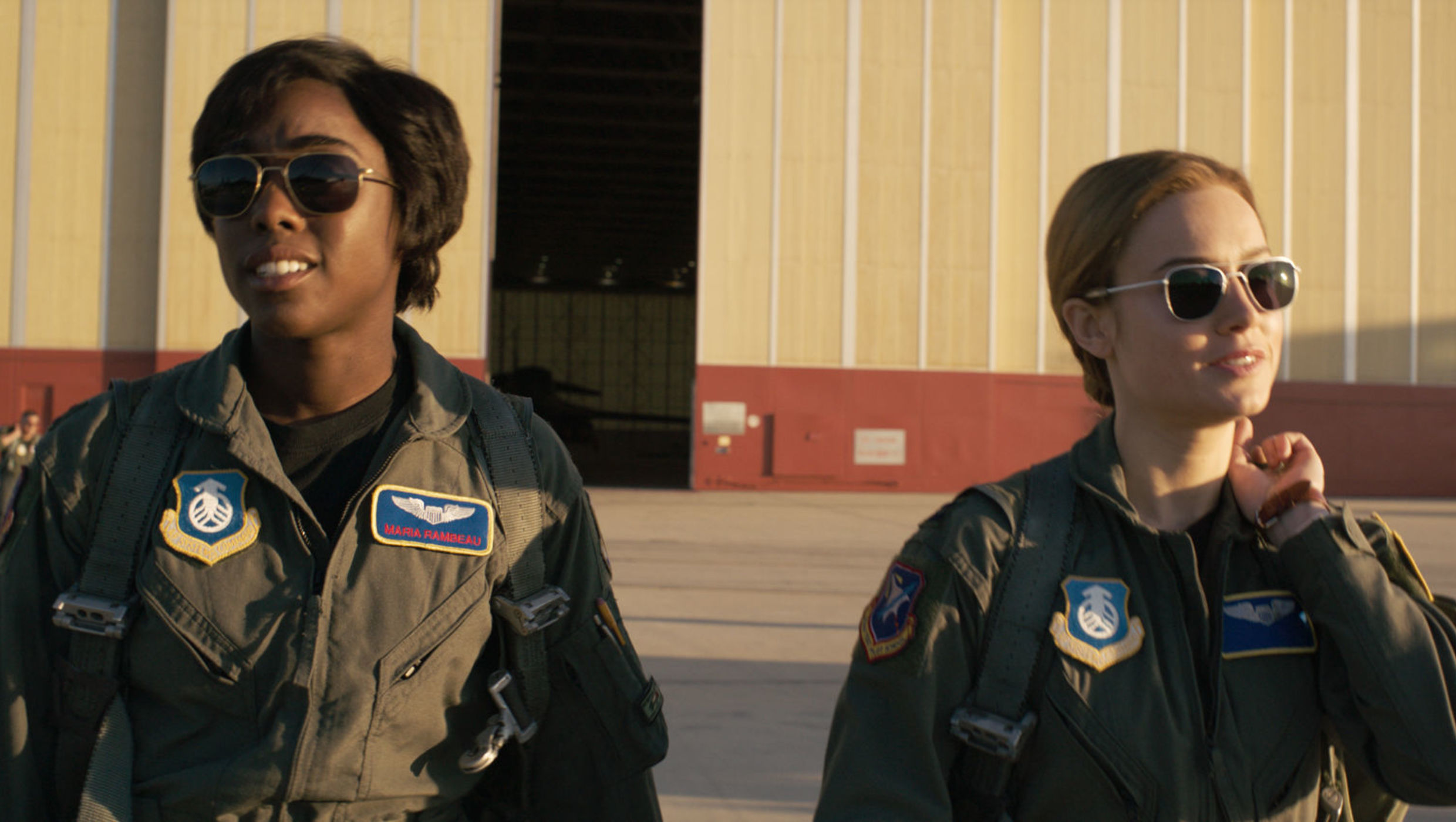
We have been pushed to think that any relationship other than romantic relationships have lesser importance. Yet Captain Marvel doesn’t shy away from showing that Carol is made stronger by the bonds she forms with others, and her relationships inform her decisions and shape her path.
And it’s these relationships that are the emotional core of the movie. From her ‘to the death’ bond with Maria Rambeau, and their unconditional support of each other, to the unyielding trust she has on Yon-Rogg (and the later betrayal of this trust).
Carol and Maria’s relationship is key to the movie. Their friendship ticks off all the marks (functions, if you will) a ‘romantic relationship’ is supposed to give us in a movie. Mainly, it’s a source of emotional support for the protagonist.
Except that instead of forcing a romance in a story that doesn’t need one, we have a strong and amazing friendship where each person is independent and strong, yet they love and support each other tirelessly. They call each other on their hubris and remind them who they are when they’re going through difficulties. Every woman has at least one friend like that, and we should all give ourselves the opportunity to contemplate one of the purest forms of love.

Even the less explored relationships, like the one Carol and Mar-Vell had, give us enough context to know Carol is a deeply caring and affectionate person. One who will take no BS, but will not hesitate to shoot off a powerful interdimensional core in order to do what is right without regard for her own safety.
Carol’s family (the Rambeau’s) form the center of her strong moral compass. But she learns that there is a difference between being good and noble, and letting others step over you.
There’s no doubt that this is a film that focuses first on being entertaining and appealing, it’s an exciting movie that appeals to the joy of feeling like a kid watching an amazing super hero being on screen, yet it subtly delivers so much more. Much like comics themselves.
Diversity means there can be a lot of different kinds of heroes. And not only in terms of gender, but also personalities. We may ask ourselves why does a female leading character need to be ‘kind and likable’ for people to think it’s a good character? Take Tony Stark, the guy is an ass, and if he was an actual person he would probably be very unlikable. Yet we love him because he’s an ass. Female characters are no different. We all have our favourites, but we should let them be what they are.
While we are at it, we also need to judge movies for what they are. Decide what is the measuring stick we want to use for judging ‘superhero movies’ or even ‘superhero origin stories’ and let’s analyse and compare. Why do suddenly people expect flawless narrative from a blockbuster movie, yet they’re happy to gloss over the narrative problems of movies like Thor or Captain America?
It’s perfectly ok to not like a movie. But there’s a wide gap from ‘I didn’t like it’ to ‘it’s a bad movie‘.
If your problem with this movie is that you don’t identify with it, that’s alright, it’s perfectly fine. But before you bemoan about how ‘unrelatable’ the movie is, stop and check where you stand. With more than half the population being women, can we not realise that this movie probably wasn’t meant for you, or that perhaps you can enjoy a movie even if you don’t personally relate to the protagonist? (It’s also cool if you’re a woman and didn’t enjoy the movie. Yet I’ve found this is an argument mostly made by men who didn’t like the movie. To each their own, let’s all enjoy what we want and allow others to enjoy what they want.)
If you’re a guy who loved Iron Man, or Batman, think about how you felt coming out of those movies, is how a lot of girls felt coming out of movies like Wonder Woman or Captain Marvel.
Captain Marvel might seem like just one more Hero, but I encourage you dear reader to look closer. While there are many shared characteristics with characters like Thor and Captain America, Carol tackles duty, power, identity, and even relationships differently.
More than that, she represents yet another kind of hero. The more we get stories that portray our differences, the richer our entertainment becomes. She is a complex character, she’s not better nor worse than Wonder Woman, Jessica Jones, or Supergirl. They all represent different traits that are valuable in media. Representation is important, and anyone who can’t see it is because they’ve always experience media tailored to them.
I was 29 when Captain Marvel came out, and it wasn’t until I walked out of the movie theatre that I realised how amazing young men probably felt the first time they saw Iron Man. I would love for every geeky person to be able to feel that same exhilaration.
TL.DR. What Makes Captain Marvel Epic?
If this was too long or too preachy, I don’t blame you. For you I’ve decided to make a small list of the reasons why Carol Danvers / Captain Marvel is epic. You know, buzzfeed style:
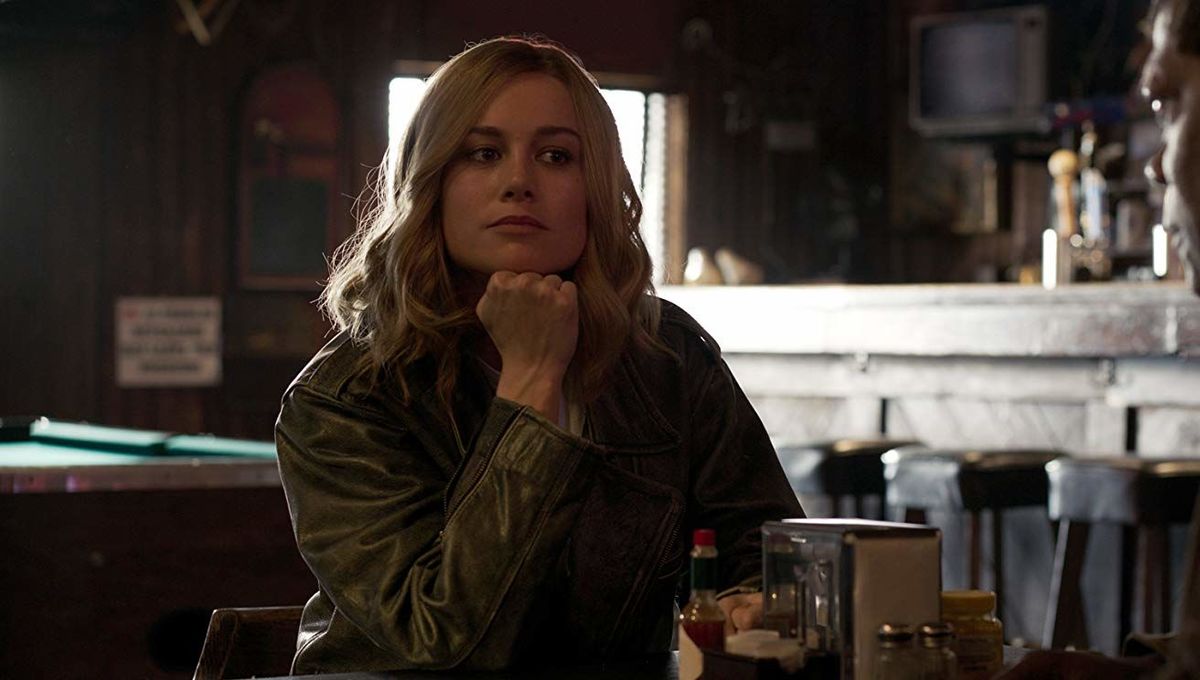
She takes no shit. Full stop.
She deals with a lot of things women can identify with. And of course there’s a lot of nods and dialogue that make reference to what we have experienced or heard through our lives, from the classic “you should smile more”, “you’re not ready”, “you’ll never be good enough”, or even the tiresome “X is not for girls”.
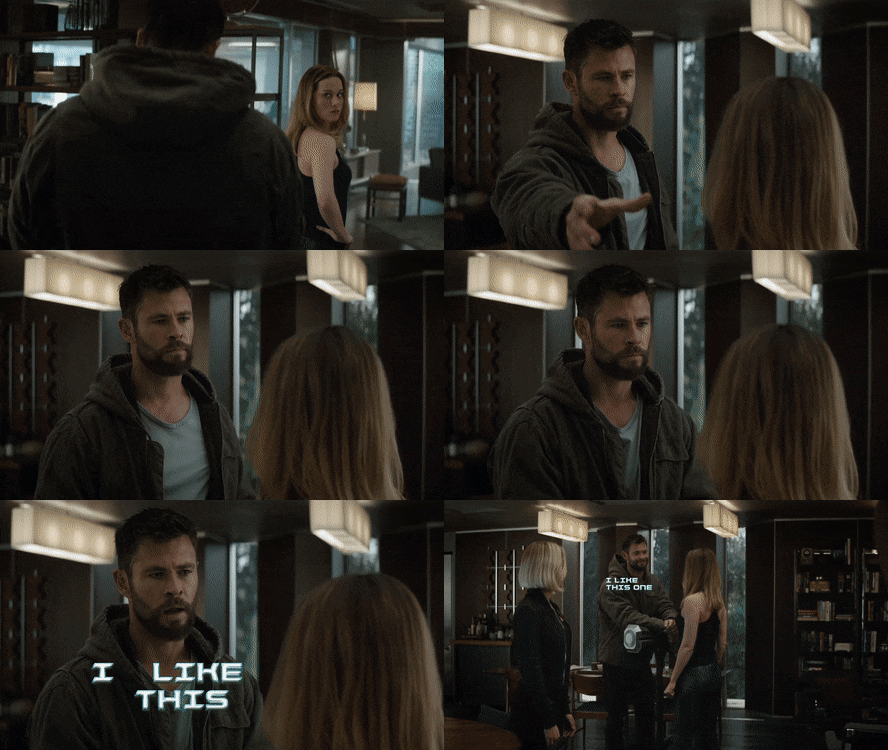
Her story is one of self discovery, because she earned her powers from the beginning. She is chosen, and she is worthy (even Thor knows that).
She ‘reaches’ for the source of her power. It’s a conscious action, even with the knowledge that reaching for “the thing” might kill her.
She’s a sassy bitch. She’s flawed, and she’s human.
She is willing to save others even if it means risking her life. But she will not do so on a whim, or foolhardy. She does not need to prove herself to you.
Her journey goes from needing to prove to others she is worthy; to knowing she doesn’t have to prove herself to anyone. That if she knows her worth she just has to be the best version of herself, regardless of who acknowledges it.
Her cat is an alien who has an interdimensional portal within her stomach.
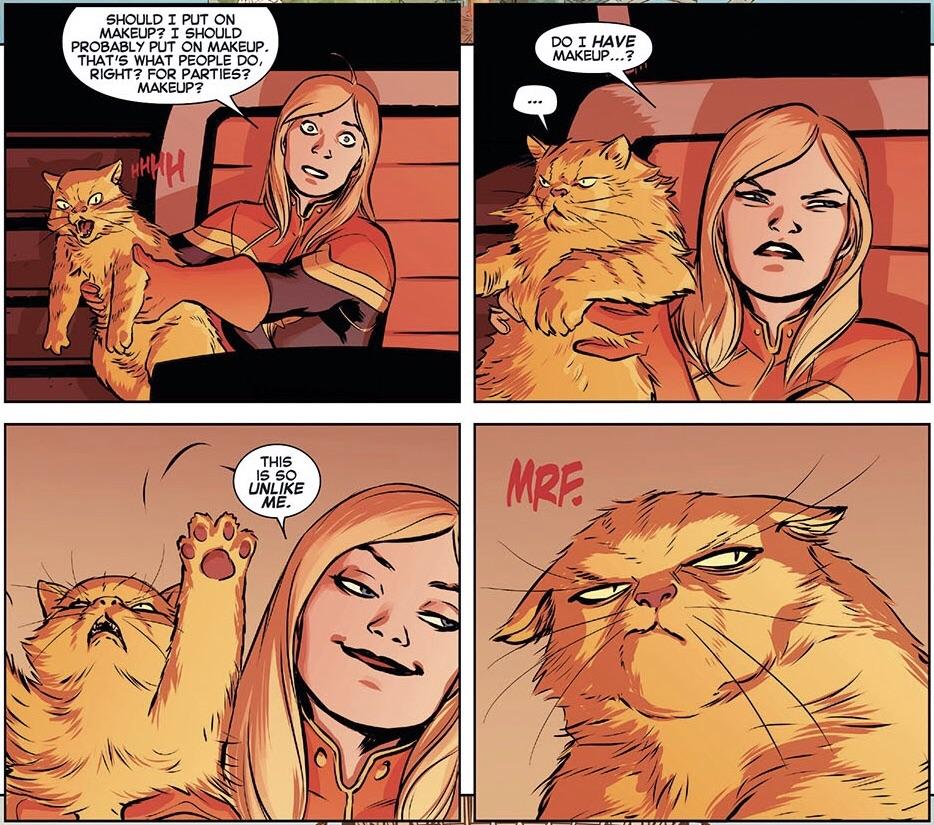
She follows her gut, doesn’t ask for permission.
She is independent but slow to trust. But once she decides to partner up, she’s someone you want by your side.
She will admit when she’s made a mistake. She knows this doesn’t make you weak.
She loves her friends and knows they are her strength.
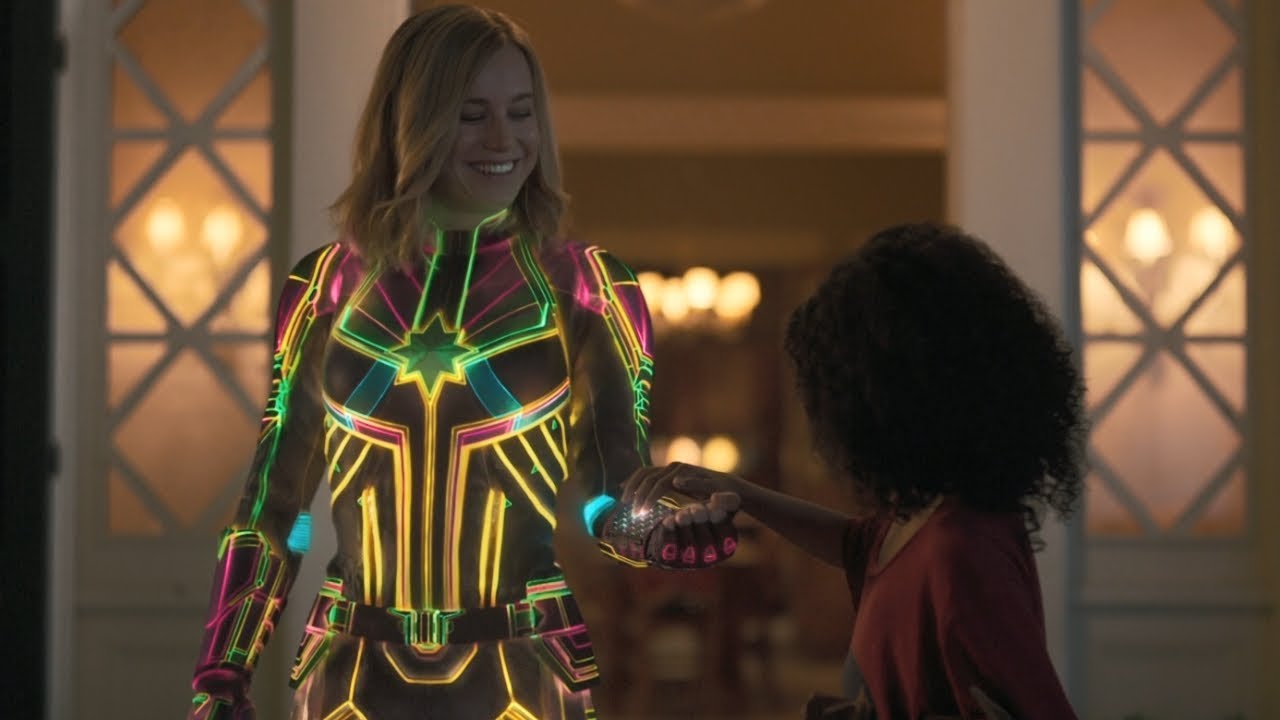
All images ©Marvel Studios, Sony, and Comics/Disney.
 PinkAiz